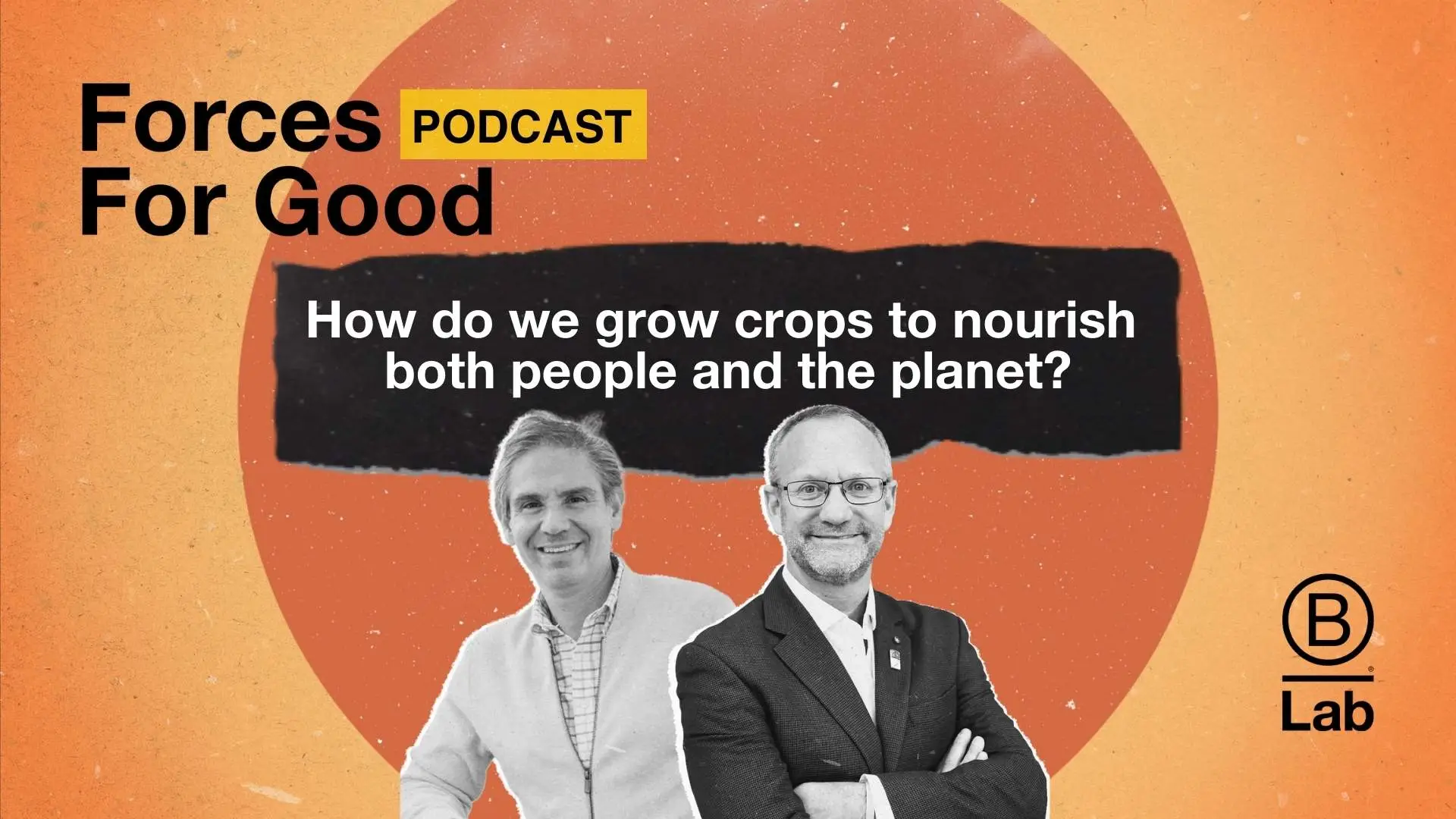
B Lab Forces For Good Podcast Season 4 — Episode 6: How do we grow crops to nourish both people and the planet?
Agriculture sits at the heart of the climate crisis—and the climate solution. While modern farming has boosted yields, it’s also fueled soil degradation, biodiversity loss, and deep inequities between the Global North and South.
In this episode of Forces for Good, we turn to two leaders driving agricultural transformation in Latin America: Gonzalo Muñoz of Sistema B and Ambition Loop, and Carlos Manuel Uribe of the Colombian B Corp Flores El Capiro.
From regenerative farming to worker-centered innovation, we explore the solutions that can reshape agriculture for people and the planet.
Listen now: https://lnk.to/forces-for-good
TRANSCRIPT: Episode 6 — How do we grow crops to nourish both people and the planet? This is Forces for Good, a podcast from B Lab, the nonprofit network powering the global B Corp movement. I’m your host Irving Chan-Gomez.
Forces for Good takes a hard look at how businesses are helping to solve the biggest social and environmental challenges of our time.
When you walk into the produce section of a grocery store it's filled with an array of products that wouldn't have been possible even 50 years ago.
Innovations from better refrigeration to faster shipping have allowed us to taste products and cuisines from around the world.
For example, I've recently been practicing making Pipian. It's a Mexican sauce similar to Mole and unsurprisingly a lot of the ingredients come from Mexico. Actually, a lot of the global supply of produce is exported from Mexico - including the chiles and tomatoes that are vital for my recipe. But for me to make this dish in my kitchen in Philadelphia, my cooking oil could have been imported from Indonesia, Malaysia, or China.
The sesame seeds and pumpkin seeds likely came from India, China or Vietnam. And of course, I always love to have flowers decorating my table - the top exporters for those are The Netherlands, Colombia, Ecuador, Kenya, and Ethiopia. More on floriculture later.
Before this turns into a cooking show I need to get back to our topic. We can't talk about agriculture without talking about the supply chain.
There's a well documented power and prosperity imbalance between the Global North and the Global South. The Global North is sometimes referred to as the Global Minority. It includes the United States, Europe, Japan, Australia and a few other regions. The Global South or Global Majority is made up of South and Central America, Africa, and Southeast Asia. Despite producing the majority of agricultural exports the Global South is hungrier and poorer than the North.
Gonzalo Munoz is the Co-Founder of both Sistema B and Ambition Loop. Sistema B is the Latin American branch of B Lab and Ambition Loop is a climate focused NGO based in Chile.
Gonzalo: We don't require more voices coming from the global north, telling the global south what needs to be done or bringing the examples of the global north to global south. We did quite the opposite, the voices from the global south to be heard. The example, the narrative, uh, the tragedy of the global south, but also for the global south to receive those solutions faster,
Our global food system is deeply flawed.
Gonzalo told me as many as 3 billion people around the world are food insecure. And at the same time a significant amount of food - up to a third of the food that is produced, is wasted.
Gonzalo: The, the, the whole of the food system is totally broken, and it has taken us too long to understand that on one side, it should not be, we should be able to feed 10 billion people without starting the planet, without destroying the forest, without depleting the oceans. Without emitting the amount of gases that affects the environment, not only as CO2, but through fertilizers, through cooling systems at the end, through food that is wasted, that decomposes and generates methane.
So all of the value change needs to be improved, but also we are taking us now to a position where we understand that it can be totally reversed. We can, and we should, and we'll. Have a system that is regenerating natural, uh, capacities, whether it is through, uh, expanding the capacity of, of photosynthesis and sequester more CO2, or producing in a way that you are restoring the soil health and biodiversity at the same time that you increase yields or produce in a way that you can bring not only.
More environmentally friendly diets, but also ones that are definitely healthier for the growing population.
Here's some good news - we have the technology and capability to feed the entire global population while also caring for the planet. But to achieve an entirely new agricultural system, we need companies who are willing to invest time and money. That means implementing sustainability solutions like regenerative farming alongside social solutions like housing, healthcare and education.
My second guest for this episode is Carlos Manuel Uribe. He's the CEO of B Corp, Flores El Capiro. They're a chrysanthemum grower and exporter based in Colombia. Social, environmental and financial sustainability is a huge part of their business strategy.
Carlos: What we care the most is, them, our workers, our employees. They have been with us many, many years.
But the night, the, the, the very cool part of this. In the past years, I have seen more young people coming to work with us. That's because we're using technology, talking about, well, we have been talking about this podcast all the time. And, the important thing is to try to bring junk generations to start working in agriculture because at the end, agriculture is the only way that we are going to have food in the world.
And if we do it right, we can help a lot, uh, the world with better techniques, better quality of our products. And the only way to do that is bring in young people that think different and help us do new things. So, so labor is our key. I, I told you that we have many workers. We focus on that. But the main issue right now is to try to capture young people to work in agriculture and in the capital.
We help a lot in social aspects, that we help with housing, we help with, um, education, we help with health. And the rotation of our people in, in, on our farms is very low. We have the lowest one in the sector. So. We try to do a good job with that because we are very conscious of the people and we're very conscious.
That is our main, uh, our main, uh, our key aspect of having a good flower to have happy people working with us.
According to B Lab's new standards B Corps must have a Climate Action Plan. Flores El Capiro's goal is to become Carbon Negative. They want their farms to sequester more greenhouse gases than they produce. This requires a lot of small changes that add up over time. Some examples include switching to solar power so 100 percent of their energy is green. Another example is more energy efficient lighting that's also better for their flowers. A third is an increase in composting.
But Carlos says one single deviation from the industry standard has made the biggest difference. Flores El Capiro ships their inventory via sea rather than air.
Carlos: So I'm going to tell you a little bit of the story. We had a 2012. We had a crisis here because the exchange rate was very low.
So at that moment all of the exporters of flowers here in Colombia started to get bankrupt and we exported 100% to the United States.
So when we were in the middle of that crisis, I saw that a Dutch company called the Dutch floor Group, sent that container from South Africa to Holland full of roses. During those days, one of their buyers was coming to check what was, if there was a business here in Colombia for them.
And I managed to receive the guy and talk to him. And I told him, look, I would like to send out a floor container full of presents to you guys, and if it doesn't work. You don't pay it because we were in the middle of the crisis. We were going to be bankrupt at any moment because everyone was lowering the prices.
The exchange rate was bad. So the only lifesaver that I had was that, so, we did the trial and that's what was the one that told you that when it re, when they receive the container, they receive 20% of the flowers. Good. 80% were bad. So I told him, look, if 20% is good, we can start working on that.
Flores El Capiro continued to innovate in the types of Chrysanthemums they exported and the manner of refrigeration. Now they ship the vast majority of their flowers via marine transport.
As of 2023, they had saved six hundred and fifty eight thousand tonnes of CO2 just by changing their transportation method. That's equivalent to the annual emissions from about 91,000 single family homes. It would take a year for 31 million trees to offset that amount of emissions. Imagine if more agricultural companies looked up and down their supply chain for ways to innovate.
We have a. A big team here, and I also have a leader in the sustainability part and a leader in innovation.
A, a leader in innovation and we have our own meetings and what we do. Is that we scout what new technologies are around the world? But a very important thing is that we work very closely. We are local universities with young people trying to get them involved in agriculture but with new innovations. So we put a lot of, to those universities.
Carlos: If you are a, if, if you are already in the business of agriculture, the main thing is to work. Very close handed with local universities, local authorities, and do like the golden triangle help each other because everything is different in, in every part of the world.
Innovation and implementing new solutions is key to fixing our global food system. But change can be scary, especially for small holders or legacy farmers. Gonzalo explains that innovation requires one to invest both money and time.
Gonzalo: Like if you're a farmer, it's not that you wake up every morning and say, I'm gonna destroy the world. You want to have the earnings, the benefits for feeding your family and for having a life being. And you know that farming is already tough, like you are exposed to, as I said. All the, uh, difficulties in relation to the economy, but at the same time, everything that is related to a climate and environment that is changing, you are affected by the drought, you're affected by heat waves, you're affected by, uh, cycles of temperature and, and the plant doesn't adjust immediately.
Okay, I get it. No, no worries. It's gonna be a little freezing, but we'll produce anyhow. No. The plant, the animals will produce a certain range and we, uh, have been farming. We know about that. So farmers are being affected, that they have always been managing very high risks. So adding an additional risk of shifting where somehow a very, uh, new, innovative way of producing means a lot of extras.
So we needed extra tools, most of them financial tools to navigate that uncertainty of transition that might require, in some cases, 2, 3, 5 years for a farmer to shift from, let's say, a conventional damaging system to one that is regenerative. At this point, we have enough evidence for almost every crop and every side type of production that you can increase yields, you can increase productivity, you can reduce costs by adopting these new practices that some of them honestly are not that new.
In order to understand how we move forward we have to figure out how we got here. We started the episode by telling you that there are items in your local supermarket that wouldn't have been there 50 years ago. They're there, in part, because of the Green Revolution. That's a term for innovations made in the 1950s and 60s that enabled the global food system to feed our growing global population. Things like chemical fertilizer and pesticides. Now, the world needs a just transition to improve upon and fix the issues left by the Green Revolution.
Gonzalo: We had so many blind spots. Uh, and, and again, maybe that some of those blind spots were just like people deciding not to listen to scientists or, or specialists on environmental health issues that were saying, wait a minute, this is dangerous.
Or simply saying, I mean, we really honestly don't think that that's. That part. Right. The world has become smaller in that sense, in the last 15, 60 years. Right. Due to the expansion of population and the expansion of production. Now it's evident to us that, and, and also due to our capacity to know, right, and to explore.
Nowadays, we know much more about everything that is happening on the earth. We cannot just say, oh, no, let's, uh, let's not think about it, or let's, uh, reduce its importance. We don't have much more import, much more information, much more scientific data. So in the end, we don't have all of those blind spots.
And the opposite, we have much more information about the damages we created due to that. Almost in every sector of the AgriFood value chain, you will find. Very huge in the organizations doing the work to reverse. 'cause one of the things that is for me, most attractive is to find so many companies in every sector from wine, as we were saying, to potatoes, to, uh, strawberries, to daily products, to wheat, to soybean, so many.
Big companies say, I wanna try the reverse. I wanna try to restore it. I wanna try to see whether we can produce the same type quality product in the scale that we are producing, but in a way that will restore nature in a very short period of time. I'm talking about not more than five, six years, the scale of regenerative agriculture.
Has gained a momentum that is extremely significant. Probably one of the most important moments was at COP28,in Dubai in the Emirates. While the Emirates as a country decided that food and agriculture was gonna be one of the most important topics, they wanted to create a breakthrough in their agenda.
Globally. So we put it together, uh, a declaration from 160 countries saying together that we need to, uh, shift to a, uh, a food and agriculture system that is sustainable, that is food or better for the planet for people.
That means tons of companies, countries, individuals and non profits are committed to improving soil health, water quality and biodiversity. We're heading in the right direction but there's still a lot of work to do.
Gonzalo: So this is a major. Major paradigm shift, and it's fascinating how fast we have seen this being adopted and embraced by all types of organizations around the world, from smallholder farmers to multinationals, from small municipalities to governments, from financial institutions to NGOs and academia. It's really, that's the story of hope that we need to embrace and accelerate.
We've only scratched the surface of this topic. There are so many innovations in the field, inspiring stories and serious commitments. If you want to learn more about the commitments countries, companies, and NGOs are making you can check out the ‘COP28 Declaration on Sustainable Agriculture, Resilient Food Systems, and Climate Action’.
You can also visit AmbitionLoop.Earth and their page on Agriculture and Food Systems. And if you haven't already, go listen to our first episode of this season "How Are Businesses Putting People at the Heart of Climate Action?" We have an excellent example of regenerative agriculture in B Corp, Yerba Madre.
If you'd like to learn more about B Corps and purpose driven companies visit BCorporation.net. And listen to the rest of our season! Please subscribe, rate, and review the podcast on Apple Podcasts, Spotify, or wherever you listen. Your ratings and reviews help Forces for Good reach new audiences, so we thank you for your support.
For more opportunities to engage with us, follow us on social media.
The views and opinions expressed are those of the interviewees and do not reflect the positions or opinions of the producers or any affiliated organizations.
The podcast was brought to you by B Lab. Special thanks to Sherri Jordan for coordination. Forces for Good is produced by Hueman Group Media.
I’m your host, Irving Chan-Gomez. Thanks for listening. And I look forward to catching you in the next episode!