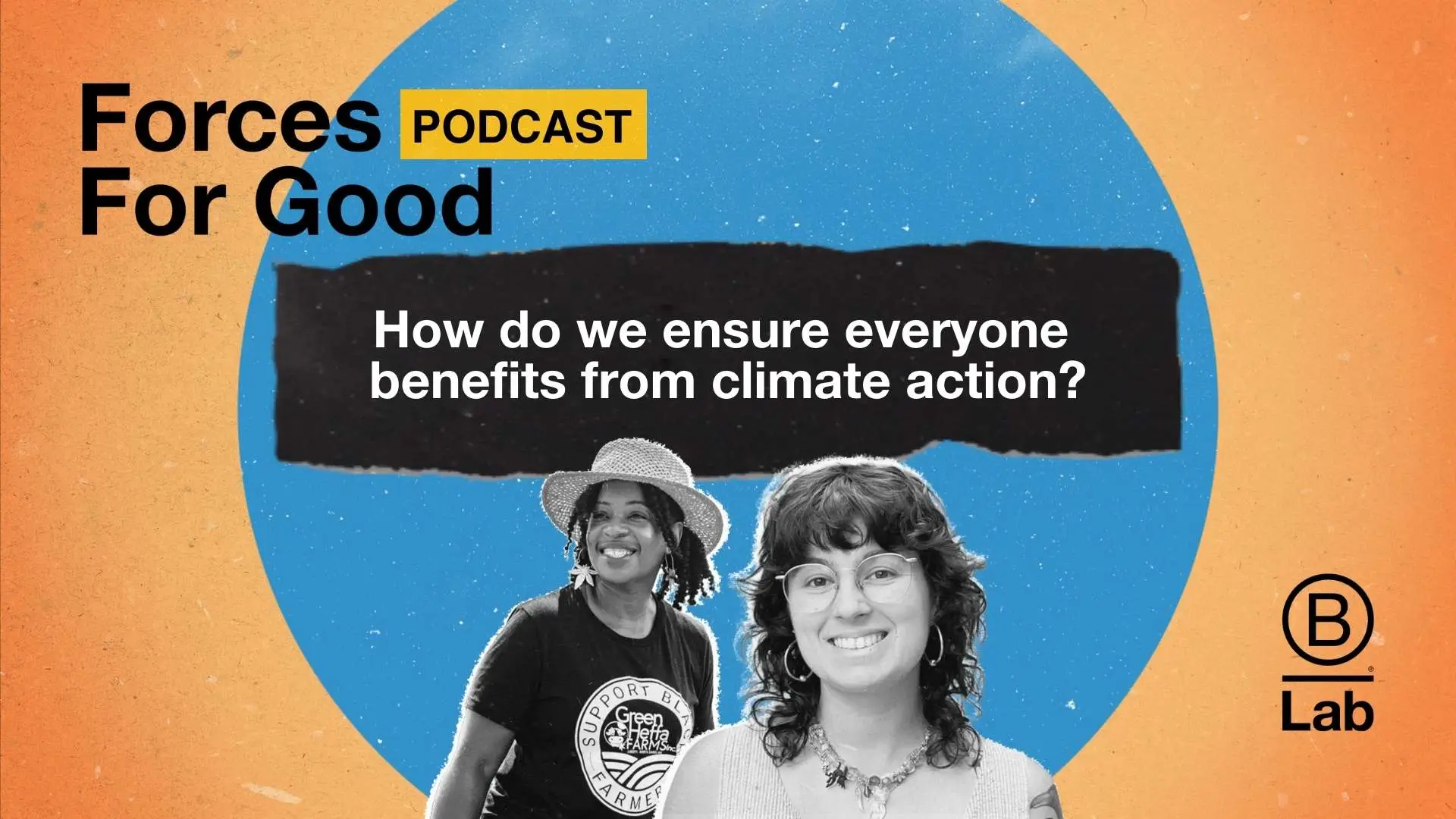
B Lab Forces For Good Podcast Season 4 — Episode 7: How do we ensure everyone benefits from climate action?
Many businesses want to act on climate, but few know how to do it in a way that’s truly equitable.
In this episode of Forces for Good, we explore the Principles for Partnership with Frontline Communities, developed by B Lab and partners. Joined by contributors Clementina Consens and Clarenda Stanley of B Corp Green Heffa Farms, the conversation focuses on how companies can move from intention to implementation, and why fair partnership is essential to long-term climate solutions.
Listen now: https://lnk.to/forces-for-good
TRANSCRIPT: Episode 7 — How do we grow crops to nourish both people and the planet? This is Forces for Good, a podcast from B Lab, the nonprofit network powering the global B Corp movement. I’m your host, Irving Chan-Gomez.
Forces for Good takes a hard look at how businesses are helping to solve the biggest social and environmental challenges of our time.
Close your eyes. Picture nature.
I picture the ocean in the Gulf of Mexico, black sand the result of the volcanic belt coming to an end in these coasts. There’s tropical forests around, banana, papaya and palm trees abound. Iguanas abound too, alongside many birds.
My producer told me she pictures the botanical garden near her college. Different kinds of trees, flowers, bugs, animals.
What do you picture?
No matter what, you're seeing an array of colors and species and we're all picturing different places, different flora, and different fauna.
Do you see where I'm going here? Nature is beautiful because of its biodiversity. Perhaps all we need to do to save it is follow its example.
Clarenda: I happen to be of the opinion that we cannot attain environmental or climate justice in a system that does not respect equity and inclusion and diversity, which is what nature is, right? Biodiversity. It's all about, you know, nature not existing in isolation.
That's Clarenda Stanley, farmer, entrepreneur, climate justice advocate, and CEO of Green Heffa Farms. Throughout the episode, we'll affectionately refer to her as Farmer Cee.
Clarenda: So I'm from the south, and my thought process was I'm on the first thing smoking out of here. I never had plans to be a farmer. It's, too, you know, the work is too hard. The payoff isn't necessarily there. My grandparents, of course, were black farmers in Alabama. So just tons of inequities are built into that agricultural landscape. And I eventually, after trying on a few roles, landed in philanthropy. I'm a fundraiser by training.
So I have worked on all aspects of fundraising, and before farming, my specialization was principal gifts. And that means that I am working with the world's wealthiest individuals on a global scale and aligning their philanthropic objectives with the work of the organization. So I was jet-setting all over the world. Gonna save it by burning it. Carbon miles along the way, and, ended up in a position where I was dealing with tremendous amounts of racial animus because I was expected to have a hundred-million-dollar conversations and not mention equity. And that was in complete contradiction to the work that I have built up over the years and to who I am as a person.
Farmer Cee built Green Heffa Farms to prove that purpose and profit are not mutually exclusive. So of course, it became a B Corp.
Clarenda: I believe that it is possible to do good business and to yield enough of a profit, to live a comfortable life, and to ensure comfort for those who engage with you. I, you know, wild idea, and I'm gonna do it. And not only am I gonna do it. As an entrepreneur, I'm gonna do it in agriculture because the agricultural foundation of our country pretty much feeds into every major industry that exists. And it's fundamental we get it right at ground level, pun fully intended.
And so I set about building Green Heifer Farms. And showing that you can source intentionally, you can prioritize the environment. We have what's called the four E's. We prioritize economic prosperity, equity, education, and the environment. And that's the framework for which I've built the business,
Now, as B Lab works to implement more ambitious, rigorous standards to raise the bar for businesses, Farmer C is helping us out. She's working primarily with our US and Canada Team. Clementina Consens is Senior Associate for Climate Justice on that team.
Clementina: In my first position, coming out of a degree in environmental geoscience, which very early on I realized was very heavily geared towards mining and oil extraction in terms of what it actually prepared you for.
So my next best bet was to get a job with a nuclear power company. And I ended up working, thankfully, exposed to their environmental and indigenous relations team. But I started to realize that I felt that the conversations that I was hearing on the team of the Soy Ojibwe nation, which was the folks that we had the privilege of working with, were highly geared towards a holistic approach towards business, towards understanding relationships to the environment, and towards equity.
As Clarenda has very eloquently put it, there is no nature without diversity; there is no nature without being part of the land that you're on. And it was through this relationship to the Sau Ojibwe Nation that I was able to recognize I really wanted to work more closely with indigenous communities.
B Lab recently published the Principles for Partnership with Frontline Communities . We wanted to give B Corps a place to start in climate justice. We all believe that we can't talk about climate action without talking about climate justice.
Clarenda: Climate justice isn't just about reducing emissions and the environmental impacts; it's also about talking and addressing who suffers. And who benefits? And so globally, the people who have been least responsible for climate change, often in the global south, are paying the highest price. And that is unjust. And so climate justice is asking us to shift power and resources. To ensure equity and solutions, and to center the voices of those who are most affected.
Clementina: There is no true climate action that does not take into account the experiences of those most impacted. As Farmer Cee said, they're the front lines, they're the community's most impacted, and in many cases, they're the community's most knowledgeable.
Partnership, collaboration, respect, and teamwork are all necessary to run a profitable business. So it's not a huge leap to suggest that B Corps apply these values to their communities. Throughout this episode, I'll share each principle with you along with how the Climate Justice Design Team thinks business can start to achieve them. Together we can find a green transition that is 'mutually beneficial and equitable instead of transactional and harmful.'
Clementina: Businesses want engagement from their shareholders, from their stakeholders, from marketing, from all the, like, they're constantly trying to tap into their communities. And we're asking them to go one step further, we're saying, instead of tapping into this community at the end, you know, after you've made all these decisions and after you've put out the product or after you've set out this service, include them at the start. Think about, you know, what are the impacts you're having and who are the people who know those impacts most intimately? And who are the ones who will come up with the most creative solutions? Your employees, your community, your frontline members, the people who are most impacted by your operations. And that's really where I think the principles for partnership shine as an opportunity for businesses to take leadership in designing through a lens of climate justice.
The first couple of principles are Center Trust and Transparent Communications, and Center Local Wisdom and Perspective.
Clementina: So what the principles for partnership really highlight for businesses is that if you operate in isolation, you won't know what your community needs and you won't know what your community needs from you. You don't know what risks you're taking, and you don't know the impacts that your operations have.
And so the principles for partnership really highlight this opportunity for businesses to take experts, who are their community members, who are the frontline communities, which are those with lived experience, and integrate them into their decision-making process so that they are making decisions from a truly informed perspective.
B Lab used the very ideals that are instilled in these principles to come up with them. Those include collaboration, trust, and good listening. Farmer Cee, as well as many other B Corp leaders and climate justice advocates, were instrumental to the process.
Clarenda: So the conversation was definitely approached from. Various lived experiences and perspectives were represented, and the representation was broad. It was extensive. And so we were all able to come together because we were united in the outcome that we sought to see, and that was providing some guidance, and to really move this forward for the B Corp community.
And for me, it was really important to be part of this because of my background in the environmental, uh, sector. Also, because I am aware that sustainability isn't inherently just, and sustainability alone. Just means maintaining or preserving resources, but that without an equity lens, it can leave communities behind.
And businesses have a huge role. Uh, businesses are often behind much of the carbon output, the environmental degradation. And collectively, the business community has enough resources to invest in solutions. But if companies don't consider who is harmed and who is helped, then they can sometimes unintentionally reinforce in equity, um, for example.
Working in the environmental space, I would see the pushing of green solutions that were inaccessible to low-income communities or the displacing of workers by the adoption of some sort of technology. And so I want it to be part of it. Something that would make businesses more aware that when they think about climate justice, it can't only be about reducing harm, but it has to be about building trust and resilience and creating long-term sustainability. I believe that if the green transition doesn't include a social justice lens, then the people who face the most barriers will continue to get left behind. And that includes our low-income workers, rural farmers, uh, communities of color, small businesses. This means lost jobs, less access to land, or the ability to adapt.
And so climate action can't just be about technology. It can't just be about renewable energy. It has to be about people, opportunity, and rights. And from the agricultural standpoint, my farm actually is actually the first black-owned farm in the US to become a certified B Corp. And the reason I wanted to be in those rooms was to, uh, express exactly what, what I've just shared with you.
We can't have a green future if green is only for the people who can afford it. And climate justice means that we have to take care of the planet. We have to take care of the people who've been carrying the heavy, the heaviest burdens all along. And so that's why it was very important for me to ensure that green heifer farms and the agricultural voice were included in these conversations.
So, what are the rest of the principles, and how do we implement them? Principle 3 is Commitment to Equitable Resource Allocation. That means using your resources - your people, your budget, and your power - to support calls to action from local grassroots movements and frontline communities. Principle 4 is prioritizing racial and cultural literacy.
Clementina: What you might have to start thinking about, and, and maybe the challenge and advice is that if your business doesn't have that language, the principles for partnership offers. The way that you might be approaching conversations or decision-making could be too narrow.
Mission operations, and as farmers, CSO eloquently put values, what the B Corp movement has is that with the new standards, with what pharmacy was talking about, businesses don't have to compromise their values if their values are in alignment with. Being in relationship to the planet and being in relationship to the communities that they're a part of, and being in relationship with abundance or profitability, uh, you don't have to fundamentally change how you're doing business.
Principle 5 is Center Conflict Acknowledgement and Trust Regeneration. No matter how well-intentioned a business is, historical inequity is baked into society. When missteps occur, restorative justice frameworks should be used to consciously repair relationships.
Clementina: take a step back, decenter yourself, listen and open yourself up to relationship building. That is what ecosystems are about. Relationship building. How can I be in a relationship with you? What are the ways that I can learn from you? What are the ways that I can offer you my perspective, my lived experience, and what can we build better together
Principle 6 is having a Clear and Equitable Decision Making Process. Businesses must make conscious decisions and collaborate with frontline communities.
Clementina: I would recommend anyone in a position within their organization. To start having conversations around what it means to really shift your perspective and your approach to decision-making. So again, coming back to that core message, climate justice is the how of your businesses.
I would say for individuals, um, and businesses to really look for opportunities to be intentional in every step of the process, oftentimes we become so. Laser-focused or developed tunnel vision on certain aspects of the business to develop partnerships.
But there's so many others you can look at who you're sourcing from, what vendors you're engaging with. How does your corporate board look? You know, does it reflect your values? Um, there's opportunities to.
Think more, think not only about just selling whatever it is that you're selling, but in creating access, education and, and economic opportunities. And how can you incorporate equity [00:18:00] more into every step of the process? Again, you know, you want to, to live your, your values and to embody the principles every day.
So when you're thinking about processing and packaging and minimizing waste and using recycled materials or thinking about your environmental footprint, also think about. The ways that you are sharing knowledge and the ways that you are engaging so that you are not contributing to uh, a movement that's limited to privilege few. And just lastly, I would say that every little bit does matter. Oftentimes as an individual, you feel that the problem is so vast. It's so big. Maybe I'm not in the position of power or authority at my organization. We are all little walking PR machines these days, and even if you have an audience of 200 that.
That is a lot, that is much more than the generation before us had access to. Um, you've got young people that have, you know, tens of thousands, millions, sometimes of people that are influenced by them. So I would say instead of focusing on being viral, however, let's focus on what's vital. Um, instead of being content creators, we all can be impact generators and to do what you can in the space that you exist in, and know that that is enough.
The final principle? Companies must center Long-Term and Sustainable Commitment to Ensure Our Collective Survival. All of the ideas we've laid out in this episode can't be a short term project or activation. They have to be built into the core of every business so that our green transition is inherently just for future generations.
So how is your company centering Climate Justice? Perhaps this concept is new to you or perhaps your company is already making strides. Wherever you are in your journey, we encourage you to learn more about the principles discussed on today’s episode!
If you'd like to learn more about B Corps and purpose driven companies visit BCorporation.net. And listen to the rest of our season! Please subscribe, rate, and review the podcast on Apple Podcasts, Spotify, or wherever you listen. Your ratings and reviews help Forces for Good reach new audiences, so we thank you for your support.
For more opportunities to engage with us, follow us on social media.
The views and opinions expressed are those of the interviewees and do not reflect the positions or opinions of the producers or any affiliated organizations.
The podcast was brought to you by B Lab. Special thanks to Sherri Jordan for coordination. Forces for Good is produced by Hueman Group Media.
I’m your host, Irving Chan-Gomez. Thanks for listening. And I look forward to catching you in the next episode!