B Lab Forces For Good Podcast Season 4 — Episode 8: How do we put our money to work for climate? With Seventh Generation
Many businesses are looking for practical ways to advance their climate commitments. One often-overlooked opportunity? Climate finance.
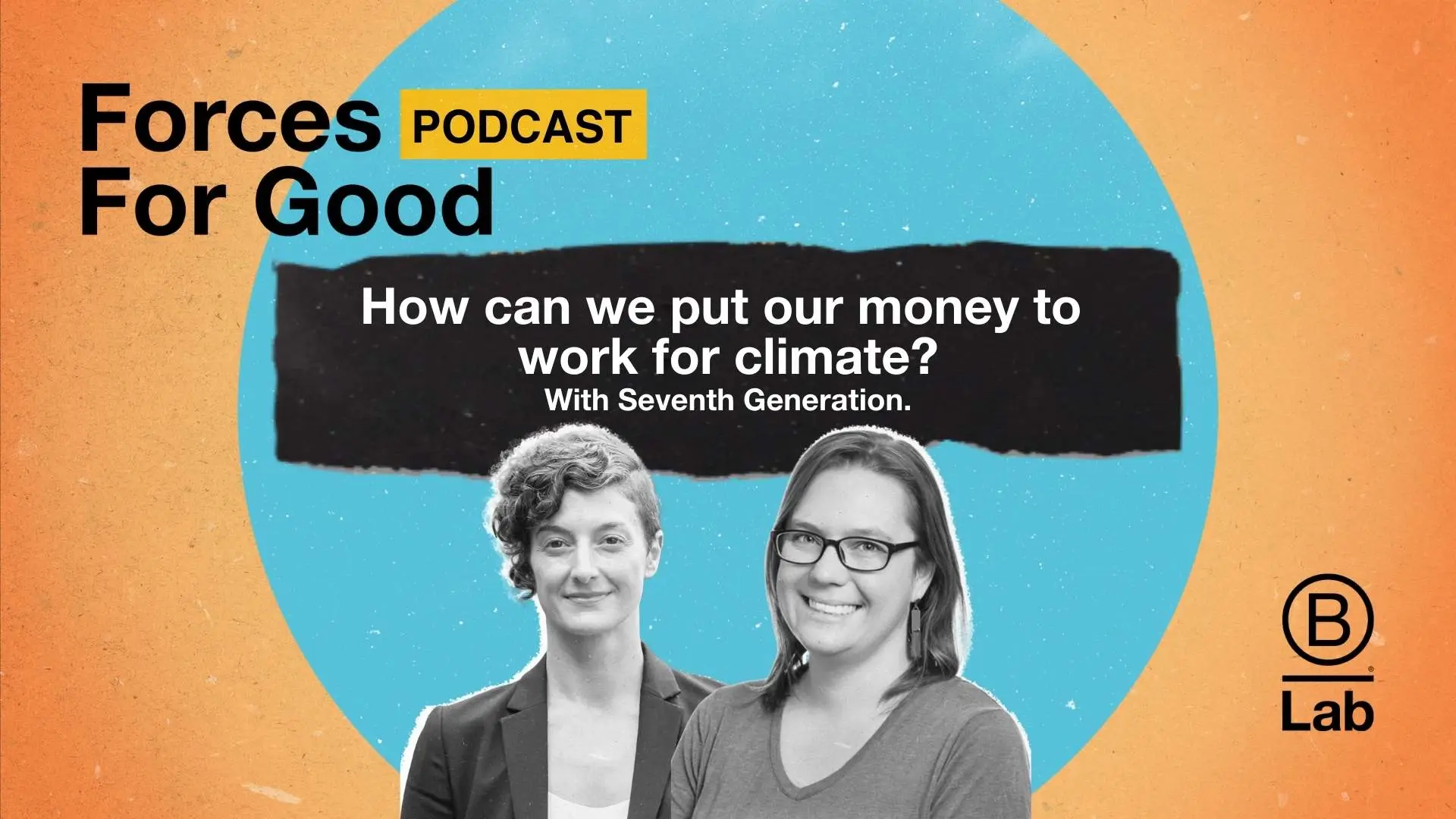
In this episode of Forces for Good, we explore how everyday financial decisions—from investments to insurance—can support credible climate action. Joined by Kylie Nealis, Senior Program Manager for Climate Justice at B Lab U.S. & Canada, and Kate Ogden, Head of Advocacy and Movement Building at B Corp Seventh Generation, the conversation breaks down how companies can get started, and why climate finance can be one of the simplest sustainability moves available.
Listen now: https://lnk.to/forces-for-good
TRANSCRIPT: Episode 8 —How do we put our money to work for climate? With Seventh Generation This is Forces for Good, a podcast from B Lab, the nonprofit network powering the global B Corp movement. I’m your host Irving Chan-Gomez.
Forces for Good takes a hard look at how businesses are helping to solve the biggest social and environmental challenges of our time.
Every single day of starting and running a business you have to be thinking about money and finances. It's how you make sure your business stays in business and profitable for the future.
But when you're speaking with your bank or pouring over spreadsheets, there's one more thing impact focused companies [B Corps we're looking at you] should be asking themselves…
Where does your money sleep at night?
Climate finance. As my guests today will explain, this is still a space without as many examples and roadmaps as other climate action spaces. But if you're not considering how your money is being invested you may be working against your own sustainability goals.
Today I'm excited to be joined by my colleague Kylie Nealis, Senior Program Manager for Climate Justice, B Lab US and Canada. She is working with a cohort of B Corps to implement climate finance strategies and create a Climate Finance Resource Guide.
Kylie: The fact is that historically we have treated our finances as a climate neutral activity. When we deposit money into the bank or we buy a financial product, you know, we treat it like it's just sitting there, like it's not generating any climate impact. But really nothing could be further from the truth.
You know, non-financial companies in the US alone hold around $7 trillion in cash and investments collectively. The emissions that stem from their cash and investments are actually larger than all of their other emissions combined. So that's scope one, two, and three. And you know, the reality is, a lot of companies don't realize this.
So you know, again, as one of our partners in the cohort, TopoFinance has framed this, you know, it's a hidden climate superpower that we all have as businesses and companies to act on.
Our second guest today is Kate Ogden. She's head of Advocacy and Movement Building at B Corp, Seventh Generation. Climate finance is the next frontier for climate action and Kate wants to lead the way!
Kate: Before I was at Seventh generation, I was at Greenpeace for 12 years. And so I have had kind of a front row seat to the origins of a lot of this work, which really comes from the climate divestment movement. A lot of it started actually on college campuses and work to get universities to divest their endowments.
So I think for me, as I started to think about what was an important next horizon Seventh Generation? This was an interesting question, which is what, given how we have a very rigorous sustainability strategy, we have this advocacy policy work that's going on, but what is the climate impact of our finances? Because if we don't know the answer to that question, then we don't have a strategy in place to mitigate it.
Seventh Generation, along with about a dozen other B Corps helped design B Lab's inaugural Climate Finance Cohort. At the time even Kylie was new to it.
Kylie: So last year we were given a generous grant to essentially launch a community of practice around climate finance. What we did at the time in early 2024 is we brought together a group of B Corp experts to help us think about how we would shape a community of practice for B Corps around these issues when we had never engaged in this before.
Luckily Seventh Generation had some experience in this space.
Kate: So we embarked on a process to try to put a number against our financed emissions several years ago. And we looked at our banking. We also looked at our insurance. We looked at our marketing services, we looked at our 401ks, we looked at our foundation. We looked at all of these different places to sort of think, try to follow the money throughout the business. One of the things that is a part of our business model is that, again, because we are a fully owned subsidiary of Unilever, we don't have separate finances from our parent company. There's no Seventh Generation where we had direct control over the decision making. We made changes right away. So the banking that sits with our corporate foundation was banking that was directly under Seventh Generation's Control. So we moved very quickly to change our banking partner with the foundation to a bank that was more aligned with both our values and our sustainability strategy around climate. And we have found Unilever to be a very engaged partner. So I think that the other piece to this work isn't just to break up with your bank or switch your financial service provider, it really is about how do you leverage the influence that you have?
One way Seventh Generation leveraged their influence and experience was to join B Lab in educating other B Corps about Climate finance. The initial cohort represented about 45 B Corps. They worked alongside climate experts and B Lab to bring Climate Finance back to their companies and take real action.
Kylie: So what we set out to do initially was think about how we can begin to convene B Corps around this issue in a way that is not just educational. So not just merely hosting a series of webinars, you know, getting this information out, but really high touch, customized support to make the shifts. We wanted to see companies moving their money.
B Lab brought financial experts into the cohort and offered one-on-one coaching in the opening session. Then everyone worked together over a 4 month program to implement climate finance. Some of these B Corps moved quickly!
Kylie: Those 45 companies in the inaugural cohort business climate finance towards a just transition last year, they represented six and a half billion dollars in revenue. You know, so here we are thinking as our kind of theory of change to start this work. Well, what if just 25% make a shift? That's the kind of climate impact that we can have. So we had 30% after that initial cohort, which ran for four months and over the summer, 30% made a shift. That means that they actually move their money to a climate friendly partner or solution. Another 40% told us that with a little more time and support, they would be able to make a shift within the next year.
Look how quickly some of these B Corps were able to move their money! Climate finance provides an opportunity for large scale impact without massive changes to a company's production or supply chain.
Kate: I think climate finance can often include where you are investing your money among other things. And the decarbonization of your finances is really about how do we make sure there's a lot of difference, there's a lot of different work streams on this but as our collaborator Paul Moinester often says, it's really about where does your money sleep at night?
Paul is one of the financial experts B Lab brought in to guide our climate finance work. He's founder and executive director of Topo Finance. I have to thank him for that phrase! I think it really sums up why climate finance is actionable and important. Also thanks to Kate for sharing it with us!
Kate: I would say on average about 20% of the cash holdings in financial institutions is lent out to do, among other things, build out new fossil fuel infrastructure. So new pipelines, new oil export terminals. There. So there's a case to be made that depending on who you bank with, the money that you keep with that financial institution might be working pretty hard against your climate strategy.
And so how do you leverage the choices that you have as a business and as an individual, but also how do you leverage the influence you have as a client of those institutions to either change where your money sleeps at night, or change the practices of that institution to be more climate positive?
Money talks! The more companies that are looking for green funds in which they can invest, green retirement plans, even green insurance. The more financial institutions will offer them. Marketing and insurance are two particularly interesting areas to consider when building a climate finance strategy. Marketing, in particular, is an area that B Lab is addressing in our new standards; Marketing and advertising agencies are required to limit their work with harmful industries like fossil fuels to 1% or less of their business revenue.
Kate: The modern public relations industry as we know it was really created to support the big oil companies, a hundred years ago. And the PR and creative industries, unfortunately, are still a quintessential part of the fossil fuels indu industries. Ability to maintain their social license 2025 when the impact of the climate crisis is more and more painfully clear. And so what that has meant for seventh that we surveyed all of our marketing survey provider partners and asked them, not only did they have. Climate goals and climate strategies that they were working against, but we also worked on them, asked them whether or not they had a fossil fuel industry because at the end of the day, the dollars that we are spending with those agency partners is not only going to support our work, but it is. Therefore also potentially funding the fossil fuel industry's ability to put out their message about their business, which unfortunately is frequently quite misleading.
So that, not only I think are the PR and creative industries and another really important lever to play, but it's also a huge line item for a lot of companies. And we have worked with Clean Creatives now for many years. They have a pledge that is available for freelance creatives and for creative and PR agencies to sign, essentially to commit to not working with fossil fuel industry clients, you're looking for a great agency and you don't know where to start, they have an excellent database on their website. Everyone that has ever signed their pledge, there's thousands of industries on there, or thousands of agencies on there now, and you can look a really great that will meet your needs and know that the money you're spending on that agency is not being used to spread mis and disinformation about the climate crisis or about the fossil fuel industry.
Climate finance will become easier as it becomes mainstream and more businesses demand decarbonized financial institutions and partners. Plus aligning yourself with similarly minded companies [like B corps!] is just good for business as well as people and the planet. I also want to let Kylie explain how huge the impact of changing insurance providers can be! It's such a hidden impact area.
Kylie: Um, we partnered with a B Corp called Premiums for the planet and they are an incredible B Corp. That's really an approach to be able to have companies as a collective change the insurance industry and really think about how our insurance premiums are spent and invested. If you're a company with, let's say, $10 million in revenue, you know, you'll spend about $200,000 a year on most insurers, the default option is they, they invest those premiums and they underwrite risk across other sectors.
Right now, the status quo is that about $60,000 of that 200,000 would get invested into carbon intensive now, only about 600 per year, 0.3% might reach genuine and so there's this incredible lever that we have insurance and we were really happy to be able to partner with in the cohort to be able to, you know, say to B Corps there's another option. You can actually join this network and you can ensure that you are going to climate remedy solutions.
Last episode we talked about climate justice. We shared with you our Principles for Partnership with Frontline and Impacted Communities. If you haven't listened to that episode yet please go back and listen when you're finished here. Climate finance is an important piece of climate justice.
Kylie: But climate finance as a whole is also just about how we fund money into global south countries, into global south communities. And that's a huge piece. And so, you know, for us right now, we are not at the point where we are focusing on climate finance in terms of that global north to global south funding stream. But we're getting there.
So for example, I'll just say that for our second session of the second cohort. Which launched this November, we'll hold that February 25th so that we can have more companies join us on a rolling basis. And for the first time, we'll actually have a module in that session on what we call funding to lower middle income or LMI countries. So how can B Corps actually play a role in funding some initiatives on the ground in the global south, there's lots of different ways that that could be done.
You know, there's on the ground credit unions, there's new models around like diaspora, communities in the US helping to fund communities in the global south where they're originally from. But the reality is climate finance as a whole globally is incredibly unjust and it's quite alarming when you think about the stats around how much funding is truly going to developing nations to be able to curb the climate crisis where they are versus how much is being held in the global north. So things like loss and damage is another way to think about this and the idea of climate reparations money going back to countries and communities that have been hit first and worse by the climate crisis as part of this.
And on that global piece, I'll just say, you know, one of the really stark stats that I've learned recently, a report that came out from Oxfam earlier this fall is that actually two thirds of climate funding for the global south has been made as loan. So really what we're seeing is that 65% or so of this funding has been delivered in the form of loans, meaning that essentially like for every $5 a country in the global south receives to mitigate the climate crisis, they're paying $7 back. That's not justice.
These numbers are really powerful, and illustrate how much important work there is to do in our fight for climate action. Finance is critical in supporting a just transition. Before this episode, climate finance may not have been high on your company’s agenda - but every business should explore what is possible. And we have some resources that can help:
Kylie: So one of the things that was really important to us when we led the Community of Practice last year was, we said, okay, 45 B Corps. That's tremendous. We're really happy to have that as a starting place, but what can we provide to the entire B Corp community or all companies for that matter, to be able to access this information?
So one of the things that we did is we were able to develop a guide. It's quite robust. That came at the end of the Community of Practice. It was published about a year ago last fall. And what this guide does is it essentially defines climate finance. So it runs through what Kate and I shared in this episode around the why, the impact, the stats. But then it goes into really concrete recommendations and steps around change management, how to convince your leadership, how to get buy-in from your C-suite on this and your team, how to engage your current providers, how to scope a new provider to make these shifts. And then it goes into concrete action steps around each lever.
So for banking, exactly. Steps one through, you know, five, how do you start this work for retirement, for insurance. And then one of my favorite parts is it has a section on companies that have already taken action. So we had some really great conversations with companies in the cohort, including Seventh Generation and others that have already done this work. And they gave us some testimonials, what it was like for them, and the why.
And then there's a resource library at the end of the guide as well as a directory of B Corp certified banks, retirement plan, asset managers and insurance companies, in the US and Canada.
If you or your team is based in the US, the second climate finance cohort that Kylie just mentioned is the perfect place to start. You don't even have to be a B Corp! Otherwise, we encourage you to check out the Climate Finance Guide that you can download simply by googling "B Lab Climate Finance Guide."
I'm so glad we were able to finish this climate focused series with these two episodes on Climate Justice and Climate Finance. And though we’re wrapping up, the action doesn't end here… At a recent event during COP 30 in Belem, former U.S. Vice President Al Gore captured the urgency: “The antidote to the climate crisis is demonstrating the alternative”.
B Lab’s new standards support and push companies to be more ambitious and more just in their climate based work. We want to see continuous improvement. B Lab and Forces for Good will keep driving the narrative that a brighter, more hopeful future is possible!
If you'd like to learn more about B Corps and purpose driven companies visit BCorporation.net. And listen to the rest of our season! Please subscribe, rate, and review the podcast on Apple Podcasts, Spotify, or wherever you listen. Your ratings and reviews help Forces for Good reach new audiences, so we thank you for your support.
For more opportunities to engage with us, follow us on social media.
The views and opinions expressed are those of the interviewees and do not reflect the positions or opinions of the producers or any affiliated organizations.
The podcast was brought to you by B Lab. Special thanks to Sherri Jordan for coordination. Forces for Good is produced by Hueman Group Media.
I’m your host, Irving Chan-Gomez. Thanks for listening. And I look forward to catching you in the next episode!